What Is a Content System?

A few years ago, clients started coming to us with a problem that sounded something like this: We’re making a lot of content. It just doesn’t seem to be adding up to anything. They weren’t necessarily making bad work. They had social teams, agencies, production partners, internal creatives, influencers, media plans, campaign calendars, and more ways to make things than ever before. The problem was that every new assignment seemed to start over. New brief. New idea. New production. New set of assets. Then do it again next month. That’s where a content system can help.
So what is a content system? A content system is a repeatable idea, structure, and process that allows a brand to keep making useful content without starting from zero every time. It defines what you’re trying to accomplish, what kinds of stories you tell, where those stories belong, what they should feel like, and how one piece of work connects to the next. The goal isn’t to make everything look the same. It’s to make everything add up to something.
A content system isn’t a content calendar
A content calendar tells you what you’re publishing and when. That’s useful. You probably need one. But knowing that you need an Instagram Reel on Tuesday and a YouTube video on Thursday doesn’t tell you what either of those things should be about. A system operates one level above the calendar. It gives the people filling that calendar a set of ideas, formats, themes, rules, and priorities they can return to. Instead of asking, “What should we post this week?” you can ask, “What’s happening this week that fits into the things we’ve decided are worth talking about?”
That’s a much easier question to answer.
It’s not a campaign either
Campaigns and content systems can overlap, but they’re not the same thing. A campaign usually has a specific objective and a defined window. You launch a product, introduce a new positioning, drive holiday sales, or get people to do something. Then the campaign ends. A content system is designed to continue. It might contain campaigns. It might react to cultural moments. It might produce recurring series, product stories, educational content, films, photography, events, creator partnerships, or things nobody anticipated when the system was created. The important part is that those things share some underlying logic.
You’re building an engine, not just filling a calendar.
The problem usually isn’t that you need more content
This is where we think a lot of brands get stuck. The internet has created an almost infinite appetite for "stuff". Every platform wants something different. Social teams need to post. Paid teams need variations. Sales needs materials. The website needs refreshing. Somebody wants a newsletter. Somebody else wants a podcast. The obvious answer is to make more. Sometimes that’s the right answer. Often it isn’t. Before increasing output, it’s worth asking whether the content you already make has a clear job. Is it building awareness? Creating affinity? Explaining a complicated product? Driving consideration? Helping someone buy something? Giving an existing customer another reason to care?
Not every post needs to generate an immediate sale. But every content effort should have a reason for existing. More content without a system can just mean more disconnected things competing for the same budget and attention.
Start with what only your brand can say
One of the first questions we’ve been asking recently is: What can this brand make that only this brand can make?
That’s a harder question than “What should we post?”
Most brands have access to the same platforms, formats, trends, creators, AI tools, stock libraries, production techniques, and increasingly similar piles of data. If your content strategy begins with “We should make some TikToks,” you’ve started at the least differentiated part of the problem. The useful material is usually upstream. What does your company know? What does it have access to? What does it notice that other companies don’t? What stories are hiding inside the organization? What can you show people that they can’t get somewhere else? What does your audience actually want from you?
A strong content system grows out of those answers.
Then create some rules
“Rules” sounds restrictive, which is exactly why we like them. A blank page gives you infinite possibilities. That’s not always helpful. A good system narrows the field. It might establish a handful of recurring themes. Certain visual behaviors. A point of view. A few repeatable formats. Rules for when something should be polished and when it should feel immediate. A definition of what belongs on one channel versus another. Those constraints give the creative team somewhere to start. We’ve found this over and over again in our own work. Creativity doesn’t necessarily get better when every possibility is available. Sometimes it gets better when you know what game you’re playing.
The trick is creating rules that generate ideas rather than rules that simply make everything look the same.
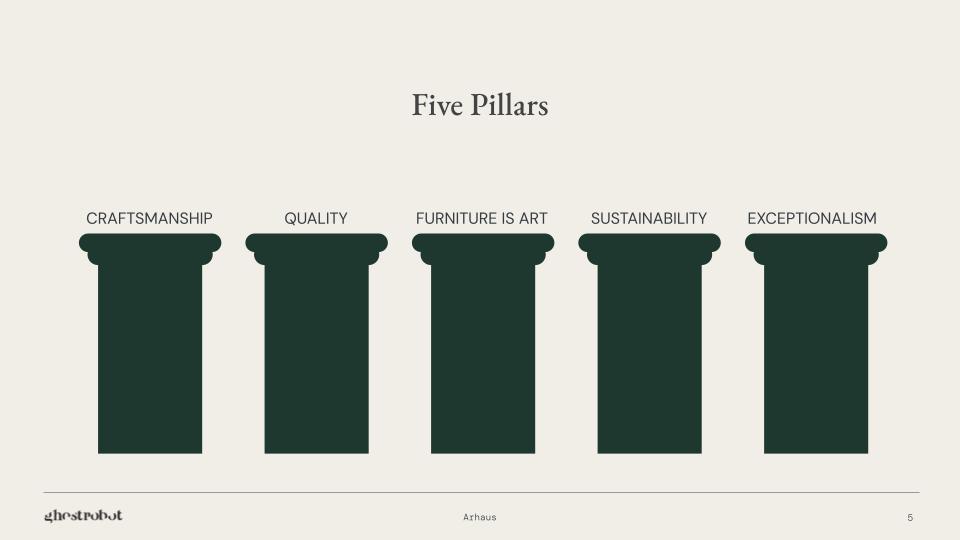
Our work with Arhaus is a good example
When we started working on social creative for Arhaus, the problem wasn't a lack of beautiful imagery. Arhaus already had plenty of that. The opportunity was to give the brand more dimension, moving beyond product-focused content to explore the much richer world around it: craftsmanship, sustainability, design, materials, artisans, art, architecture, and the people behind the work.
But we didn't start by making content. We started by building the system that would make the content possible.
We established recurring creative territories that could support dozens of different ideas. Craftsmanship could become maker profiles, sketches, swatches, artisan voice notes, and behind-the-scenes footage. Furniture as art could lead us into architecture, gallery-style imagery, unexpected cultural references, and collaborations. Sustainability could become stories about materials, sourcing, reuse, and the natural world.
The important thing was that we weren't committing to any one execution. We were creating a framework that gave us room to experiment, learn what resonated, and keep pushing the creative without losing the thread of the brand.
And that's exactly what happened. What started as a system for social content eventually gave us the foundation for a much bigger, highly effective brand campaign. We were able to move beyond individual posts and product stories into something more ambitious: a distinctive world built around the lifestyle, aspiration, and personality of Arhaus.
The system didn't just help us make more content. It helped us discover what the brand could become.
That's the real value of a content system. It creates consistency without demanding repetition, and gives you enough structure to take creative risks without starting from scratch every time.

A campaign can behave like a content system too
Content systems aren’t only for brands making things every week. Years ago, we created a campaign for the Ford Fusion called #Backatyou. The central idea was designed to generate lots of different expressions: comedy talent, social interactions, individual pieces of content, and eventually a three-hour live broadcast where we gave away a car. All told, we made more than 40 pieces of content over the course of 8 months and the campaign generated more than 11 million impressions. The important part wasn’t that we made 40 things. It was that we didn’t come up with 40 unrelated ideas. There was one central premise capable of generating many different expressions. Each piece could do something slightly different while still contributing to the larger campaign.
That’s system thinking applied to a finite campaign.

The best systems generate ideas
This might be the most important distinction. A bad content system is a template. Put the product here. Put the headline there. Swap in this week’s photo. Export. Repeat forever. Efficient? Sure. Interesting? Probably not for very long. A good content system gives you a framework that keeps generating new possibilities.
Different channels should do different jobs
Another warning sign is when every platform receives essentially the same piece of content in a different aspect ratio. Instagram isn’t YouTube. YouTube isn’t an email. An email isn’t an event. An event isn’t a website. That doesn’t mean every channel needs its own completely independent strategy. Quite the opposite. They should work together. A useful content system defines the role of each channel within a larger audience journey. One channel might be particularly good at discovery. Another might let you explain something in depth. Another might convert interest into action. Another might be where your most committed audience spends time with you.
Instead of asking how to distribute the same thing everywhere, ask how the same idea can behave differently in different places. That’s a much more interesting creative problem. Some content should be expensive. Some shouldn’t. A system also helps determine where to invest. Not every social post needs a production crew. Not every piece of content should disappear after 24 hours either. Some ideas need speed. Some need polish. Some can be shot on a phone. Some deserve a director, a crew, a set, six weeks of animation, or a ridiculous prop somebody has to figure out how to build.
Without a larger system, those decisions can become arbitrary. With one, you can ask what role the content is playing and invest accordingly. If an idea is meant to establish a major new brand platform, maybe you spend more. If its job is to respond to something happening today, speed may matter more than production value. The point isn’t to make everything cheaper. It’s to know where the money matters.
How do you know if you need a content system?
There are a few symptoms we see repeatedly: You’re making a lot but it doesn’t feel connected. Every new brief starts from zero. Your social channels are primarily driven by the need to post something. Paid and organic feel like two different brands. Different agencies or internal teams are making work without a shared point of view. You have a strong visual identity but no clear editorial voice. You’re constantly asking for more ideas. Great ideas happen once and then disappear. You’re producing assets nobody ends up using. You’re spending a lot of money on content but aren’t sure what it’s collectively accomplishing.
None of these necessarily mean you need to make more. You may need a better structure for what you’re already making. So how do you build one? We’d start by answering a few questions before creating a calendar or commissioning another production. What are we trying to accomplish? Connect the content to actual business and marketing objectives. Who are we trying to reach? Not just demographics. What do these people care about, watch, share, search for, need, or find entertaining? What do we have that others don’t?
Access, expertise, stories, products, people, data, history, personality, perspective. What are the recurring territories? Find a manageable number of subjects or ideas the brand has permission to keep exploring. What is our point of view? A visual identity tells people what you look like. A point of view tells them how you see the world. What is each channel’s job? Decide where ideas belong and how they should behave there. What formats are worth repeating? Build recurring structures that audiences can recognize but that leave enough room for creative variation.
Where should we invest? Decide which ideas need real production resources and which benefit from being fast, simple, or responsive. Then start making things. The system shouldn’t be treated like a constitution. Pay attention to what works. Kill formats nobody cares about. Expand the ones that surprise you. Change the rules when the rules stop being useful. A content system should evolve with the brand and the audience.
The goal isn’t more content
It’s easy to confuse activity with progress. More posts. More videos. More assets. More channels. More impressions. Sometimes those numbers matter. But ultimately, content should be helping the business do something: become known, build affinity, explain its value, create demand, sell products, retain customers, grow an audience, or strengthen the relationship with the people it already has. A good content system connects those business goals to the things you’re making every day. It also makes the creative process considerably less exhausting. Instead of beginning every Monday with a blank page, you have a world to explore.
And if you’ve built that world well, you shouldn’t run out of places to go.
If your team is making a lot of content but every assignment still starts from zero, that’s a problem we like. We can help build the system underneath the calendar.
Something you can test
If your team invents four unrelated posts every Monday, test two recurring editorial formats for a quarter, each with a clear audience need, owner, and success measure.